


Editor’s note: Our salon series on The Odyssey continues on Thursday, March 12. The session will cover Books 9-12 (only 76 pages). A few seats are still available, and you’re warmly invited.
It isn’t until Book 5 that we meet our protagonist. We find Odysseus …
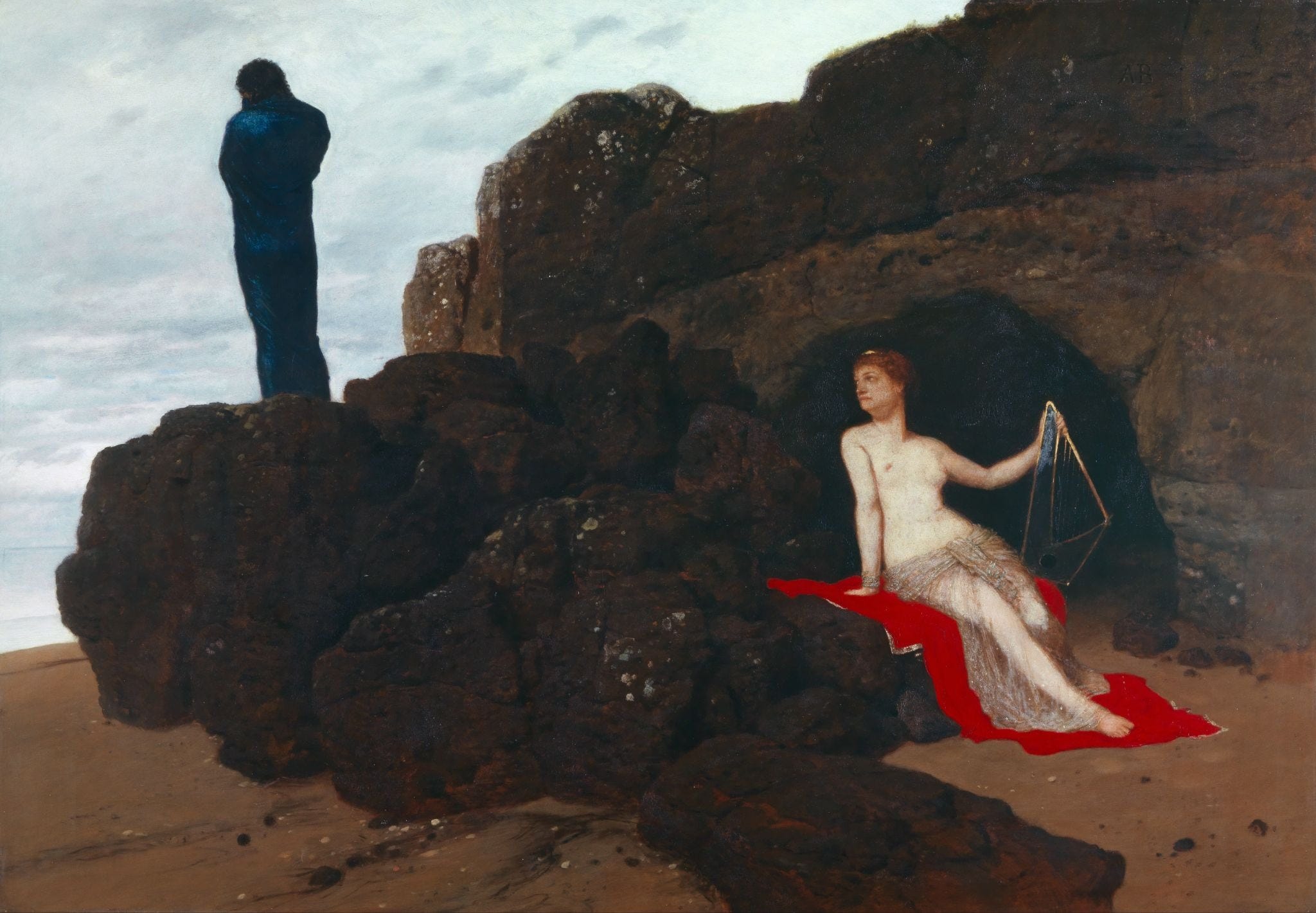
sitting by the shore as usual, sobbing in grief and pain; his heart was breaking. In tears he stared across the fruitless sea.1
Calypso, after seven years and at the direction of Zeus (himself influenced by the dogged Athena), will let Odysseus leave if he chooses. His first words immediately reveal the core of his identity. Metis, his skillful cunning. He presumes the gods are up to their usual tricks; the offer of passage back home must be a scheme against him. Calypso calls him a “scalawag” and praises his understanding of “how these things work.”2 But there is no trick, and Odysseus will make his first, and most consequential, decision.
Calypso has offered him immortality if he agrees to stay, but he refuses. Why, in Zeus’ name, would he turn down an eternity on a mythical island of plenty with a beautiful goddess?
The answer lies in nostos, or homecoming, the central theme of the epic. It’s where we get the word “nostalgia.” Odysseus is weeping on the shores of Ogygia, nostalgic for home. Let the suffering it will take to get there be damned. Odysseus craves nostos. But his homecoming can’t be achieved by simply setting foot on Ithaca. Homecoming means reclaiming his identity. He longs for himself.
In immortality Odysseus would lose himself. The verdant island has “sights to please even a god” with an ageless goddess who desperately loves him, yet it is devoid of society and pursuit.3 Without society, there can be no relational identity. He is a husband and a father. A king. None of these have any meaning away from home. Without pursuits, the multitudes he contains have no outlet. There are no tools for a master shipbuilder and no ways to apply his nimble mind. For Odysseus, to choose immortality would be to choose everlasting ennui.
During his first tentative reentry into society among the Phaeacians, his heroic identity reemerges when he is goaded into competition and wins. He is not simply returning home. He is returning to his conception of self. Odysseus’ choice to forsake Calypso and regain himself through his nostos offers a lesson for modern readers. Identity is forged through persistent action.
Action requires courage and suffering. In spurning Calypso, who is reminding Odysseus she surpasses Penelope in beauty, this is what he tells her:
But even so, I want to go back home, and every day I hope that day will come. If some god strikes me on the wine-dark sea, I will endure it. By now I am used to suffering—I have gone through so much, at sea and in the war. Let this come too.4
“Let this come too.” For a man who, we will learn, has gone through years of tribulations between the war and landing on Calypso’s island, it’s a much bolder statement than it seems at first blush. He knows he will endure an incredible amount of suffering along the way. He has no illusions that the journey will be easy, yet he sets out anyway. He has confidence in his own resilience and metis. As Wilson says in the introduction, “it is the kind of cleverness that enables one to prepare for any new challenge and come out as a winner.” One of Odysseus’ most common epithets is “much-enduring.” Odysseus knows he possesses the endurance it takes to get home.
The times I’ve been most disconnected from myself, when I’ve felt most lost, were the times that I was afraid to “let this come too.” I saw minor obstacles on the horizon and convinced myself they were as fearsome as Scylla and Charybdis. I used them as excuses not to leave the harbor. Humans have a tremendous capacity to adapt, endure, and reinvent, but only if we act. And we act in accordance with who we believe we are. Do we see ourselves as capable? Are we willing to “let it come too” knowing we have the courage, metis, and endurance to find our way?
Odysseus reminds us of what we can endure and what we might find if we do. Ourselves.
Join us!
Find all the information you need to sign up and follow along here. Join us on Thursday, March 12 for Books 9-12.
I hope to see you there! If you enjoyed this essay, here are more links related to the salon series.
Watch past sessions on Youtube
Essays:
Interintellect Hostcast podcast with Joao (summary on X)
X thread on fun little details I’m learning, updated as I reread The Odyssey
Book 5: Lines 82-84 from Emily Wilson’s translation
Book 5: 182-183
Book 5: 74
Book 5: 219-224